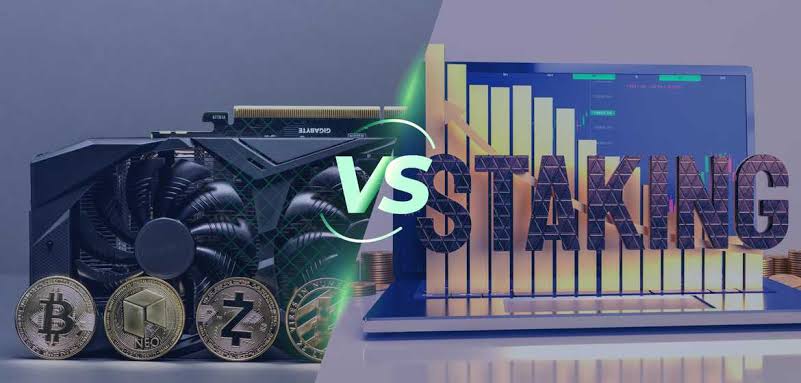
In the realm of cryptocurrencies, mining and staking are two primary methods for validating transactions and securing blockchain networks. Each has distinct benefits and trade-offs, appealing to different types of participants. Here’s a closer look at mining and staking, their pros and cons, and how to determine which might be better for you.
Crypto Mining: The Heavy Lifting
How It Works: Mining involves using powerful computers to solve complex mathematical puzzles, a process known as Proof of Work (PoW). This effort validates transactions and adds them to the blockchain. The first miner to solve the puzzle gets to add a new block and is rewarded with cryptocurrency.
Advantages:
-High Earning Potential: Successful miners can reap substantial rewards, especially with established cryptocurrencies like Bitcoin.
– Enhanced Network Security: Mining adds significant security to PoW blockchains, making it costly to manipulate transaction data.
Disadvantages:
– Energy Intensive: Mining consumes vast amounts of electricity, leading to high costs and environmental impact.
– Costly Equipment: Setting up a mining rig requires specialized and often expensive hardware.
– Risk of Centralization: Mining can become concentrated in areas with lower energy costs, potentially centralizing control over the network.
Crypto Staking: The Streamlined Option
How It Works: Staking involves holding and locking up a cryptocurrency in a digital wallet to support the blockchain’s operations. This process, known as Proof of Stake (PoS), selects validators based on the amount of cryptocurrency they are willing to lock up as collateral. Validators are then chosen to verify transactions and create new blocks based on their stake.
Advantages:
– Energy Efficient: Staking uses far less energy than mining, making it more eco-friendly.
– Generates Passive Income: Stakers earn rewards proportional to their stake without the need for extensive hardware.
– Lower Entry Barrier: Staking usually requires just the cryptocurrency and a compatible wallet, making it more accessible.
Disadvantages:
– Locked Funds: Staked cryptocurrencies are typically locked for a period, limiting access to them during this time.
– Security Concerns: If a validator node is hacked, staked funds could be at risk, though networks have measures to mitigate this.
– Inflation Potential: Staking rewards can increase the circulating supply of a cryptocurrency, possibly leading to inflation.
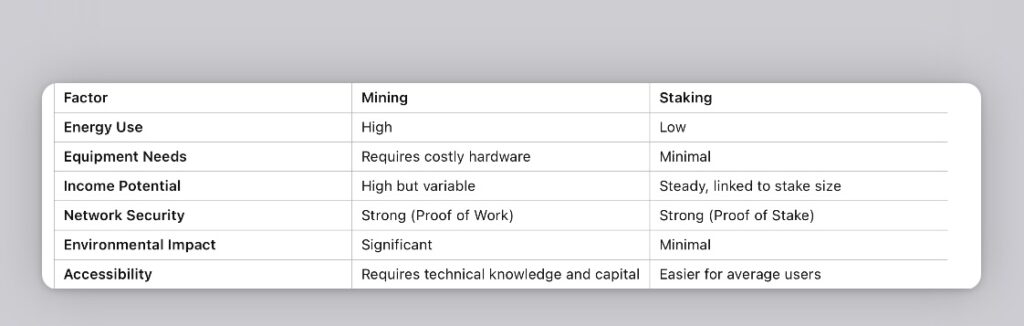
Comparing Mining and Staking
Which Path Should You Choose?
For Environmentally Focused Individuals: Staking is the clear winner due to its minimal energy use, making it a more sustainable option.
For High Reward Seekers: Mining can offer lucrative rewards, especially during times of high cryptocurrency prices. However, it comes with high risks and upfront costs. Those with the resources and expertise to manage a mining operation might find it profitable.
For Simplicity and Accessibility: Staking is generally simpler to start with and doesn’t require significant capital or technical expertise. It’s ideal for those looking for a straightforward way to earn rewards from their crypto holdings.
Conclusion: Both mining and staking have their unique strengths and challenges. Mining might suit those with the capacity to handle the costs and complexities, while staking offers a more accessible and environmentally friendly way to participate in crypto networks. Your choice will depend on your investment goals, technical skills, and environmental concerns.
By understanding the mechanics of mining and staking, you can better decide how to engage with the evolving cryptocurrency landscape.